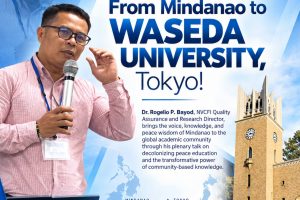


Dr. Rogelio P. Bayod to bring Mindanao and Philippine grassroots perspectives to Waseda University’s Global Leadership and Fellowship Program
WASEDA UNIVERSITY, TOKYO, JAPAN: What does leadership look like when the world is uncertain, communities are marginalized, and conventional ideas of power and authority are no longer enough?
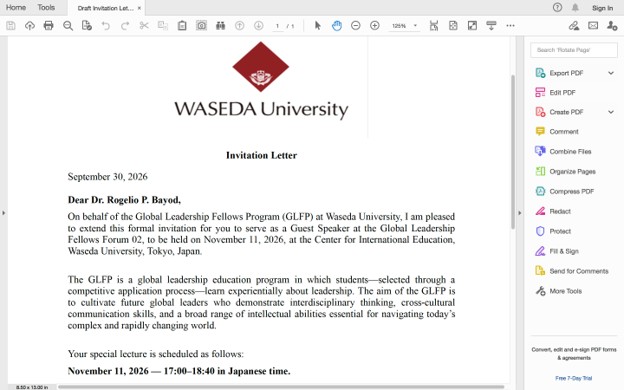
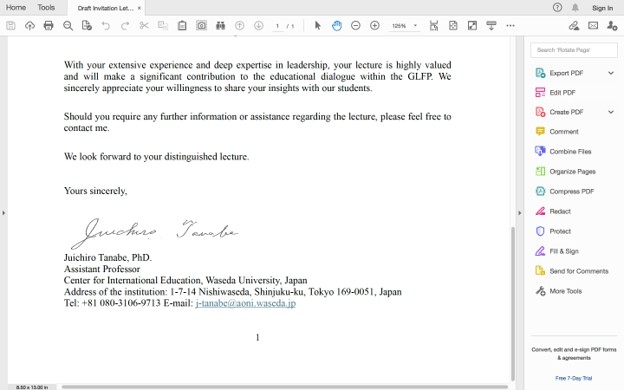
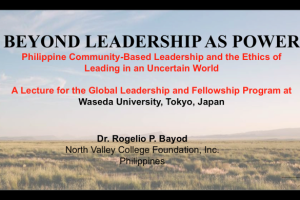
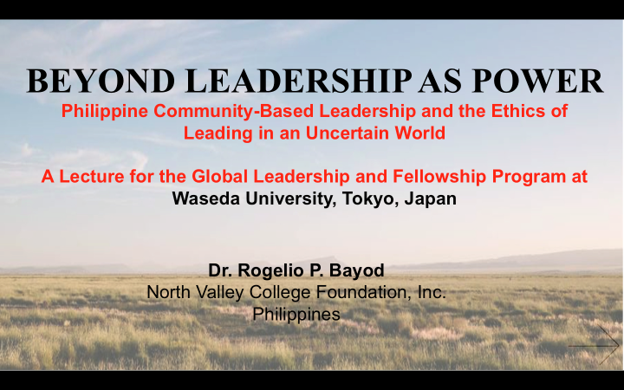
This question will take center stage as Dr. Rogelio P. Bayod, Quality Assurance and Research Director of North Valley College Foundation, Inc. (NVCFI), has been invited to deliver a lecture for the Global Leadership and Fellowship Program of Waseda University in Tokyo, Japan.
Bayod’s lecture, titled “Beyond Leadership as Power: Philippine Community-Based Leadership and the Ethics of Leading in an Uncertain World,” will bring a distinctly Philippine and Mindanawon perspective to an international discussion on leadership.
Rather than approaching leadership primarily as authority, position, influence, or the ability to command others, Dr. Bayod’s lecture will explore leadership as an ethical, relational, participatory, and community-grounded practice.
For Dr. Bayod, some of the most important lessons about leadership may be found not in corporate boardrooms or centers of political power, but in communities at the margins, among people who confront poverty, displacement, conflict, ecological vulnerability, and social exclusion while continuing to organize, care for one another, and imagine better futures.
From the margins to the global classroom
Drawing from Philippine community experiences, particularly those found in Mindanao, Dr. Bayod will invite global leadership students to reconsider a fundamental question: What kind of leadership does an uncertain world need?
His response moves beyond the traditional understanding of leadership as power over others. Instead, he emphasizes leadership grounded in listening, humility, relationality, participation, solidarity, courage, and responsibility.
Philippine concepts such as bayanihan and kapwa, together with insights from Sikolohiyang Pilipino and grassroots peacebuilding, provide important foundations for this approach.
For Dr. Bayod, listening is not simply a communication skill. It is an ethical and epistemic practice. It is a recognition that communities possess knowledge, experiences, and forms of wisdom that formal institutions and conventional leadership structures can easily overlook.
This perspective is particularly significant when working with Indigenous peoples, marginalized communities, and grassroots organizations. Leadership, in this framework, is not simply about having the power to decide for others. It is about creating spaces where people can participate in defining the problems they face, articulating the knowledge they possess, and shaping the solutions that affect their lives.
A Mindanawon voice in global leadership conversations
Dr. Bayod’s invitation to Waseda University reflects an academic journey deeply rooted in Mindanao.As an educator, researcher, administrator, development practitioner, and advocate of community-based education, he has consistently worked at the intersection of ethics, education, peacebuilding, development, research, and community engagement.
His scholarship has explored questions of decolonization, peace education, grassroots peacebuilding, Indigenous and local knowledge, sustainability, and human dignity. His work challenges the tendency to view Mindanao merely through the lens of conflict and crisis.
Instead, Dr. Bayod argues for seeing Mindanao as aspace of peace, knowledge, resilience, cultural diversity, and community wisdom. This perspective informs his broader academic advocacy: that universities should not merely study communities from a distance but should also listen to communities, learn from them, and recognize them as partners and producers of knowledge.
It is a philosophy that has likewise shaped his work at NVCFI.
NVCFI: Bringing quality education closer to people
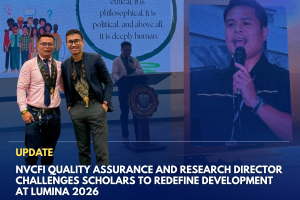
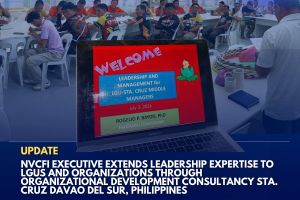
At North Valley College Foundation, Inc., Dr. Bayod serves as Quality Assurance and Research Director, helping strengthen the institution’s systems for quality assurance, research, faculty development, academic excellence, and institutional improvement.
NVCFI’s mission of providing “quality education closer to people”resonates strongly with Bayod’s own academic philosophy. For him, quality education is not simply measured by institutional rankings, facilities, or compliance with standards. It is also measured by an institution’s capacity to transform lives, respond to communities, protect human dignity, and generate knowledge that matters to society.
Under its continuing institutional development, NVCFI has increasingly positioned itself as an institution committed to research, innovation, community engagement, peace education, social development, and human welfare.
Its growing academic engagements with national and international institutions demonstrate an aspiration to bring the experiences and knowledge of Mindanao into broader conversations on education and social transformation. Dr. Bayod’s Waseda lecture therefore represents more than an individual academic engagement.
It is also an opportunity for Mindanao to speak to the world.
Leadership for a “crazy world”
The contemporary world is marked by wars, political polarization, climate change, technological disruption, widening inequality, displacement, and deepening uncertainty. In such a world, leadership cannot simply be about controlling circumstances.
It must also be about learning how to live responsibly with uncertainty. Dr. Bayod’s leadership framework proposes that leaders must be willing to listen before speaking, learn before prescribing, and accompany communities rather than simply direct them.
The leader, in this sense, is not always the person at the front. Sometimes, leadership means walking beside people. Sometimes it means creating space for others to speak. Sometimes it means having the humility to say, “I do not know.” And sometimes it means standing with communities whose voices have historically been excluded from the spaces where decisions are made.
This is the ethical challenge at the heart of Dr. Bayod’s Waseda lecture.
From North Cotabato to Tokyo
Dr. Bayod’s journey to Waseda is also symbolic of the possibilities that emerge when local experiences enter global academic conversations.
Coming from Mindanao, his work demonstrates that scholarship does not have to begin in the traditional centers of global knowledge production.
Important theories of leadership, peace, ethics, development, and education can also emerge from farms, Indigenous communities, classrooms, barangays, grassroots organizations, and communities at the margins.
The invitation to speak at Waseda thus carries a simple but powerful message:
Local knowledge can have global significance.
And the experiences of Philippine communities can contribute meaningfully to the world’s continuing search for more humane, ethical, and sustainable forms of leadership.
NVCFI and the global future of Mindanawon scholarship
For NVCFI, Bayod’s international engagement is part of a broader institutional vision of becoming a learning community that connectslocal realities with global academic conversations.
The institution continues to strengthen its commitment to quality assurance, research, innovation, faculty development, community extension, and academic partnerships.
Its aspiration is not simply to produce graduates who succeed professionally, but to develop learners and leaders who understand their responsibility to society.
The Waseda engagement provides another platform for this vision.
It demonstrates that an institution rooted in Mindanao can participate in conversations taking place in some of the world’s leading academic spaces and that the voice of Mindanao can contribute something essential to those conversations.
As Bayod brings Philippine community-based leadership to Waseda University, he carries with him not only his academic credentials but also the stories, struggles, resilience, wisdom, and aspirations of the communities that have shaped his work.From Mindanao to Tokyo, from the margins to the global classroom, the message is clear:Leadership need not begin with power. It can begin with listening. It can begin with humility. It can begin with community.